


The new art of findability: SEO, AEO, and GEO
10 minute read

So, you’re curious about the art of visibility? Welcome to the club.
Search is changing quickly, and the language around it is changing too. SEO is now joined by its siblings AEO and GEO.
It is enough to make even experienced marketers wonder whether everything they know about search is outdated.
It isn’t.
The fundamentals of findability still matter. Your business needs useful content, a technically sound website, recognizable expertise, and a strong reputation. What has changed is where people search and how they are getting their answers.
Prospective customers are not only discovering your business through a traditional search result, but they’re also now trusting AI-generated summaries or recommendations from a tool like ChatGPT. Businesses need to think beyond rankings and understand whether they are being found, represented accurately, and considered by the right audiences.
What do SEO, AEO, and GEO mean for your business?
While the terminology continues to evolve, the business goal is simple: when prospective customers search for a solution, ask a question, or compare providers, does your company show up?
Here is the practical distinction:
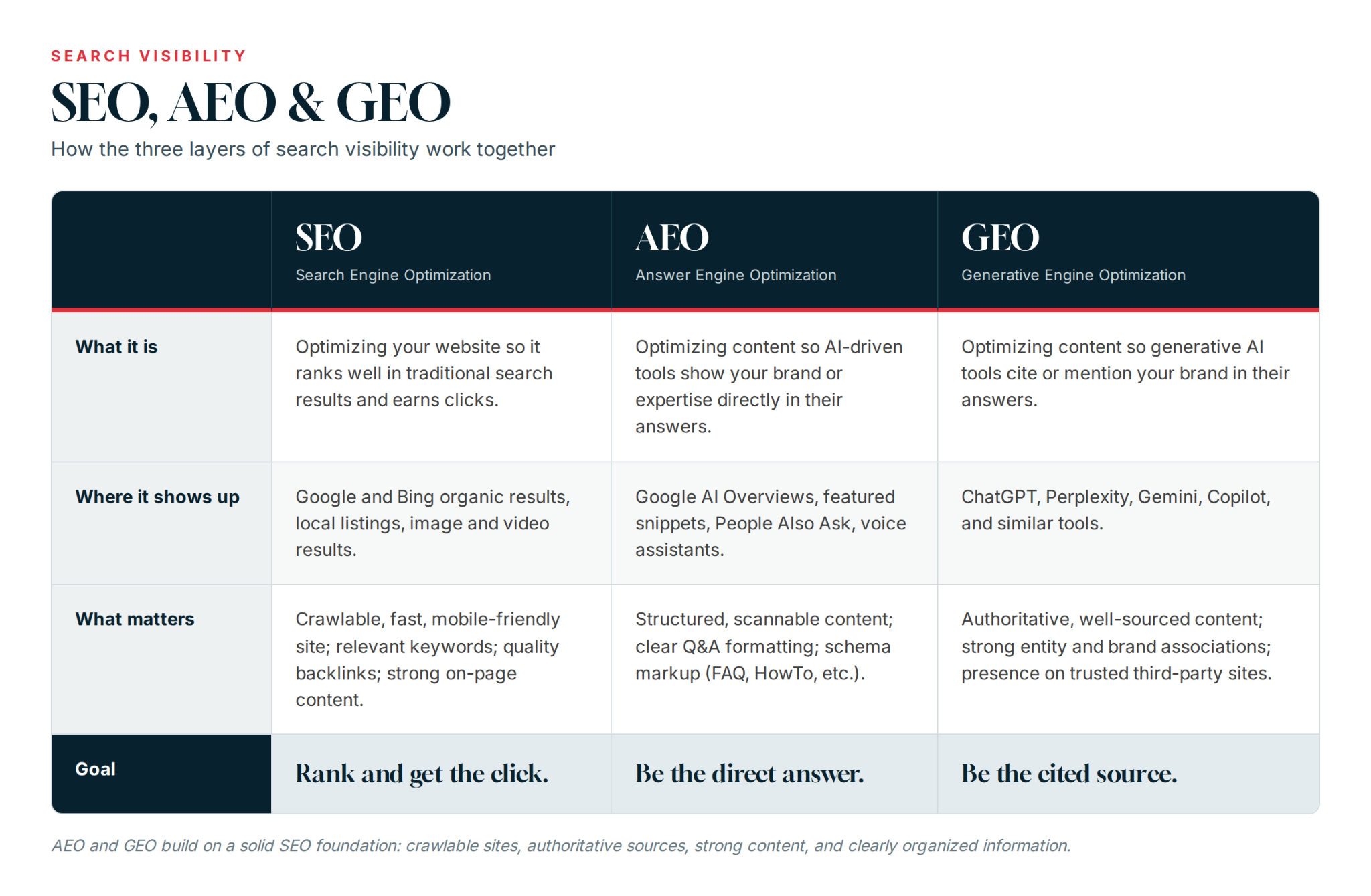
Traditional search still matters. AI platforms rely on many of the same signals: crawlable websites, authoritative sources, strong content, and clearly organized information. Answer engine optimization (AEO) and generative engine optimization (GEO) both depend on a solid SEO foundation.
These practices overlap, but are important for different questions asked by prospects. Together, they help ensure your company is not only findable but also understood and accurately cited when prospects are researching their options.
Why does AI visibility matter?
Search behavior is shifting fast. Before a business can be researched, compared, or chosen, it has to be found.
More and more, people ask a question and get the answer on the spot, without clicking through to a website. A few numbers show how big the shift is:
- 60%+ of Google searches now end without a click (SparkToro, 2026)
- 83% of searches end without a click when an AI Overview appears (Bain & Company, 2026)
- Brands cited in AI answers get 35% more clicks (Similarweb, 2026)
If your brand isn't the answer AI cites, a competitor's will be.
Traffic alone no longer tells the full story. Businesses should also ask:
- Do we show up for the questions our prospects are asking?
- Do AI platforms describe us accurately?
- Which competitors appear when we don't?
- Which sources and thought leadership shape those answers?
- Is our visibility leading to qualified engagement?
Answering these questions takes more than a glance at your analytics dashboard. In a recent post, we walked through the tools Imarc uses to track clients’ AI visibility and practical ways to adjust your content based on the findings. After all, how you show up with AI is your story, so it’s worth making it a good one.
Three steps to get you started
AI visibility is not solved through one content update or a universal checklist. Every business starts with a different combination of content, technology, authority, and market recognition.
Our approach connects three phases: audit, implement, and track and optimize.
1. Audit
We begin by establishing a clear baseline of how the client currently performs across AI answer engines, and generative search platforms.
Here are some of the things we look at:
- Question-based content coverage
- Map entities
- E-E-A-T signals
- Crawlability
- Core web vitals
- Scheme implementation
- Backlinks and mentions
- Prompt visibility comparison
- Competitive citation gap analysis and benchmark
- AI source and citation analysis
Main deliverable: Clear report of findings, prioritized recommendations, and an actionable implementation roadmap.
Useful tools for this kind of audit include SEMrush, Screaming Frog, GA4/Google Search Console, Google's Rich Results Test, and custom prompt-testing workflows built with tools like ChatGPT or Claude to systematically test how your brand appears in AI search results.
Goal: Identify the changes most likely to make a meaningful difference and prioritize those.
2. Implement
Next, we turn the audit findings into action.
Depending on the opportunities identified, implementation may include:
- Restructuring or expanding content
- Strengthening expertise and trust signals
- Resolving crawlability or technical issues
- Adding or correcting structured data
- Building relevant third-party authority
Deliverables: Completed content optimizations, technical and schema enhancements, authority-building initiatives, and documentation of the work performed.
Goal: Create progress by ensuring the right recommendations are implemented well.
3. Track and optimize
Search and AI platforms are constantly evolving. Competitors publish new content, source patterns change, and customer questions become more specific.
Ongoing measurement helps us understand what is improving and where new opportunities are emerging.
We may track:
- Prompt visibility
- Brand mentions and citations
- Accuracy and sentiment
- Competitive share of voice
- AI referral traffic
- Engagement and conversions
- Relevant business outcomes
Deliverables: A customizable performance dashboard, ongoing analysis, optional CRM or analytics integrations, and an evolving optimization roadmap.
Goal: Recognize meaningful patterns with analytics and keep the strategy aligned with business priorities.
What can this look like in practice?
Our work with Delinea shows how phased digital improvements can support measurable progress.
Delinea needed to modernize its digital presence without waiting for a full website redesign. The first phase included updates to their blog experience and then their homepage, navigation, product, and solution templates.
For the blog, we introduced clearer summaries, article highlights, author information, and structural improvements that supported usability, SEO, and AEO.
When comparing Q1 2026 with Q4 2025, Delinea’s blog saw:
- A 72% increase in key events completed on blog pages
- A 39% increase in active users
- A 37% increase in page views
- A 25% increase in total events completed on blog pages
These results reflect improvements in strategy, content, design, and development, all based on an initial analysis of their search effectiveness.
Explore the Delinea engagement
Start with what can be learned now
Search will continue to change. Businesses do not need to react to every headline, but they do need to understand how prospects find and evaluate them.
Start with these questions:
- Where are we visible today?
- How is my traditional SEO performing?
- What is preventing us from being found or understood?
- How will we implement and measure meaningful improvements?
The path forward is practical: audit what exists, implement what matters, and continue to track and optimize as the landscape evolves.
Because the future of search is not only about ranking first. It is about becoming a trusted source and a business worth finding.
Not sure how your business appears in AI-powered search? Start a conversation with Imarc.